
How to Search Clayton County Criminal Records
The starting point is the official Criminal Name Search on the Clayton County Court Case Inquiry portal. The form takes a last name and lets the user refine with a first name or initial. The court dropdown lets users pick All Courts, State, Magistrate, or Superior. The matching Criminal Case Search is for users who already know the case number.
- Open the Criminal Name Search form.
- Select All Courts on the dropdown to cover State, Magistrate, and Superior in one pass.
- Enter the last name and an optional first name or first initial.
- Submit and review the result table. Each result shows party type, name, offense, filing date, case number, status, court, and judge.
- Click the case number to open the detail page with the docket.
The result row for a Clayton criminal case shows the party type as DEF for defendant. Birth year appears under the name. The case number is linked to a detail page.
Superior Felony vs State Misdemeanor
Superior Court handles felony criminal cases. The District Attorney's office prosecutes those cases. State Court handles misdemeanor and traffic cases prosecuted by the Solicitor-General. Magistrate Court can show warrant entries and case-status notes such as Bound over to State Court or Bound Over to Sup. Ct. The two-letter code in the case number is a quick clue: CR is criminal, TK is traffic, and WA is warrant-related.
| Charge Level | Court | Prosecutor | Example Charges |
|---|---|---|---|
| Felony | Superior Court | District Attorney | Aggravated assault, burglary, drug trafficking. |
| Misdemeanor | State Court | Solicitor-General | Simple battery, shoplifting, DUI first offense. |
| Traffic | State Court | Solicitor-General | Speeding, stop-sign violation, no proof of insurance. |
| Warrant / preliminary | Magistrate Court | Issuing officer / DA referral | Initial arrest warrants and probable-cause hearings. |
The Clayton County District Attorney and Solicitor-General pages describe each office's role.
Arrest Record vs Court Record
An arrest record is a Sheriff record. A court record is a clerk record. The two are not the same. A person can be booked into the Clayton County Jail and released on bond before a formal charging document is filed. A court case will then appear on the public case portal once the prosecutor files an accusation or after a grand-jury indictment in a felony matter. Conversely, a person who turned themselves in on a misdemeanor citation may have no jail record but still have a court record.
The Clayton Inmate Information Search handles active inmates and recent booking dockets. The court case inquiry handles the filed case. For most users the two should be checked together. The inmate records page covers the Sheriff side in detail.
Comparison — Charges vs Convictions: A charge is what a prosecutor accuses the defendant of doing. A conviction is a finding or plea of guilt by the court. A charge can be dropped, reduced, dismissed, or bound over without ever becoming a conviction.
What a Clayton County Criminal Record Shows
The fields below come from a State Court traffic case inspected on the public portal. The same fields appear on State and Superior Court criminal records.
| Field | What It Shows |
|---|---|
| Case Number | Year, two-letter type, sequence, and division. |
| Assigned Judge | Judge currently handling the case. |
| Filing Date | Date the case was opened in the system. |
| Status | Disposed, Pending, See Paper File, or Bound Over. |
| Parties | State of Georgia as plaintiff, defendant, and any listed attorney. |
| Counts and Charges | Count number and plain-text charge text. |
| Docket Entries | Filings, calendars, event outcomes, receipts, and final dispositions. |
| Receipt | Receipt number and dollar amount paid. |
Privacy fields not visible in the sample include full date of birth, address, and Social Security number. Birth year appears in the name-search results.
Record Restriction in Georgia
Georgia commonly uses the term record restriction instead of expungement. The Georgia Bureau of Investigation record-restriction page describes O.C.G.A. § 35-3-37 and says it allows restriction of certain criminal-history records for non-criminal-justice purposes. Restricted records are generally not released to private persons or businesses through ordinary GCIC dissemination. Criminal-justice agencies and judicial officials may still see them.
The Georgia.gov restriction service describes the application steps and says the state usually processes complete record-restriction applications in two to three weeks. Restricting a criminal-history record at GBI does not seal the court file. A separate motion in the court that handled the case may be needed to seal the docket.
Comparison — Sealed vs Expunged: A sealed record is hidden from public view by court order; the file still exists in court records. An expunged record, where the law allows it, is treated as if it never happened for many purposes. Georgia mostly uses restriction and sealing, not expungement.
Georgia Bureau of Investigation Criminal History
A full criminal history in Georgia is a GBI / GCIC product. The Clayton court portal is a county case-inquiry tool. It is not a statewide criminal-history report. The GBI criminal history FAQ explains who can ask for a criminal-history report and how dissemination rules work.
Background screens for employment, licensing, and tenant decisions usually pull from state and federal databases, not from a Clayton case search. Users who want to check their own record can ask GBI directly. The court file in Clayton, the jail booking record at the Sheriff, and the GBI criminal history are three separate sources and should be cross-checked.
District Attorney, Solicitor-General, and Public Defender
The District Attorney's office prosecutes felony cases in Superior Court. The Solicitor-General prosecutes State Court misdemeanors and traffic. The Public Defender's Office represents eligible indigent defendants. A defendant who cannot afford a private lawyer can ask the court for a public defender. The clerk's office can supply the indigency application or direct the defendant to the public defender intake.
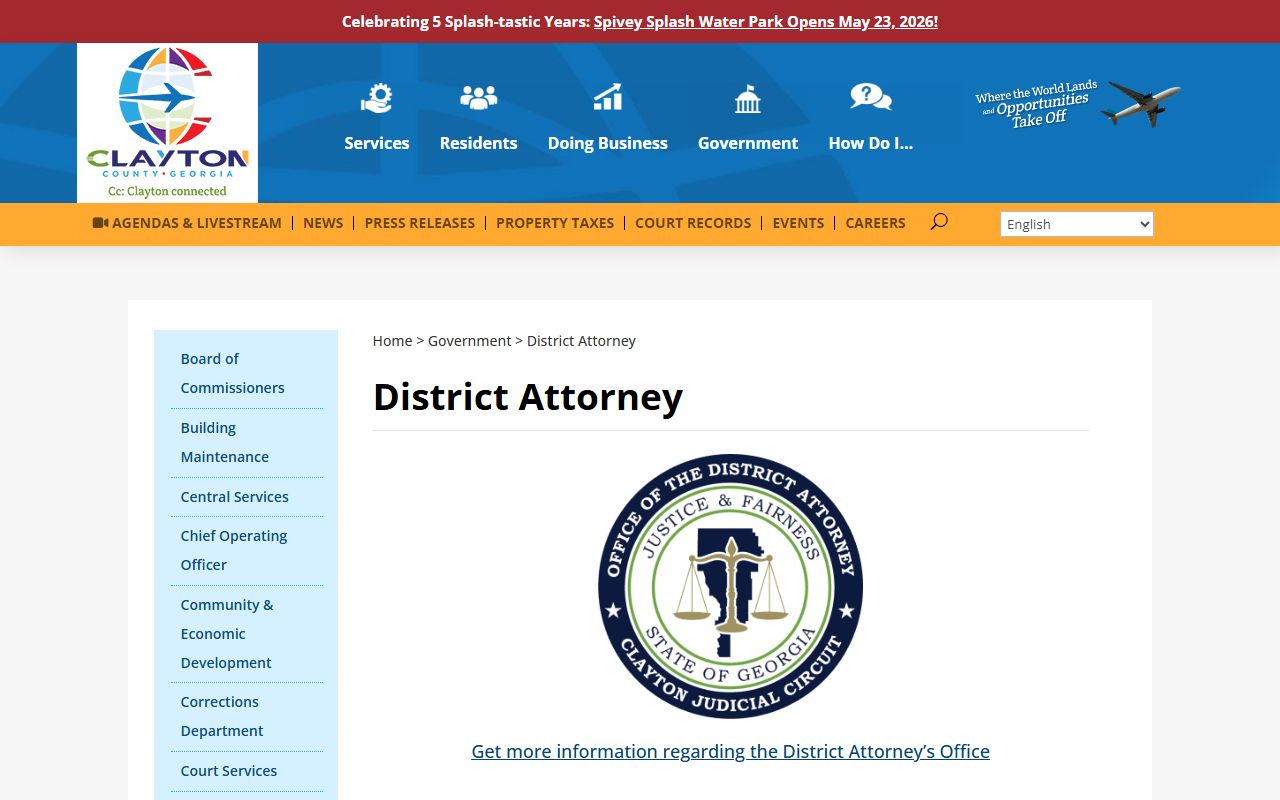
The District Attorney page above lists office contact details. Crime victims should also use the DA page for victim-services information.
Federal Criminal Cases
Federal criminal cases that arise in Clayton County are handled by the U.S. District Court for the Northern District of Georgia. The U.S. Attorney's Office for the Northern District prosecutes federal crimes. Filings and dockets are accessed through PACER and the Northern District CM/ECF. PACER charges a per-page fee under federal rules. Federal cases will not appear in the Clayton County court portal.
Restricted Clayton County Criminal Records
The Clayton court portal excludes adoption, juvenile, probate, protective order, sealed, pre-JIS, and out-of-county records. A juvenile criminal matter goes through Juvenile Court at 9163 Tara Boulevard and is governed by O.C.G.A. § 15-11-700 et seq. The juvenile file is generally confidential and is not on the public case search. A criminal matter that was sealed by court order will also fail to return any rows on the portal. Personal identifiers such as Social Security numbers and full birth dates are protected under O.C.G.A. § 9-11-7.1 and court rules and are not displayed in public results.
A first-offender disposition under O.C.G.A. § 42-8-60 et seq. can also affect how a Clayton case shows up. The First Offender Act allows a defendant to complete a sentence without a conviction of record. That treatment changes how the file is shared with non-criminal-justice users, even though the docket can still exist in court records.