
How to Search Clayton County Court Records
The official Clayton County Court Case Inquiry portal is the main search tool for civil and criminal cases in State, Magistrate, and Superior Court. The system is free, requires no account, and lets users search by party name or by case number. The landing page is the Clayton County, GA Court Search Options page. From there, users pick Civil Search or Criminal Case Search, then pick Name Search or Case Search.
Have the basics ready before you start. For a name search you need a last name and the right court. For a case-number search you need the year, the two-letter type code, the five-digit sequence, and the optional division. A subpoena, e-notice, or court notice will show the full case number in the format the portal needs.
- Open the search-options page at the county portal and choose Civil Search or Criminal Case Search.
- Choose Name Search if you have a party name, or Case Search if you have the full case number.
- Pick the right court from the dropdown: State Court, Magistrate Court, Superior Court, or All Courts for a name search.
- Enter the last name and an optional first name or first initial, or enter the four-digit year, two-letter type, five-digit sequence, and optional division.
- Open a result by clicking the linked case number, then read the case summary, parties, charges, and docket entries.
- Request a certified copy from the Clerk of Superior Court if you need a court-stamped document.
The county Court Case Inquiry page shows a banner with the available search options and a short note about the case-inquiry workflow.
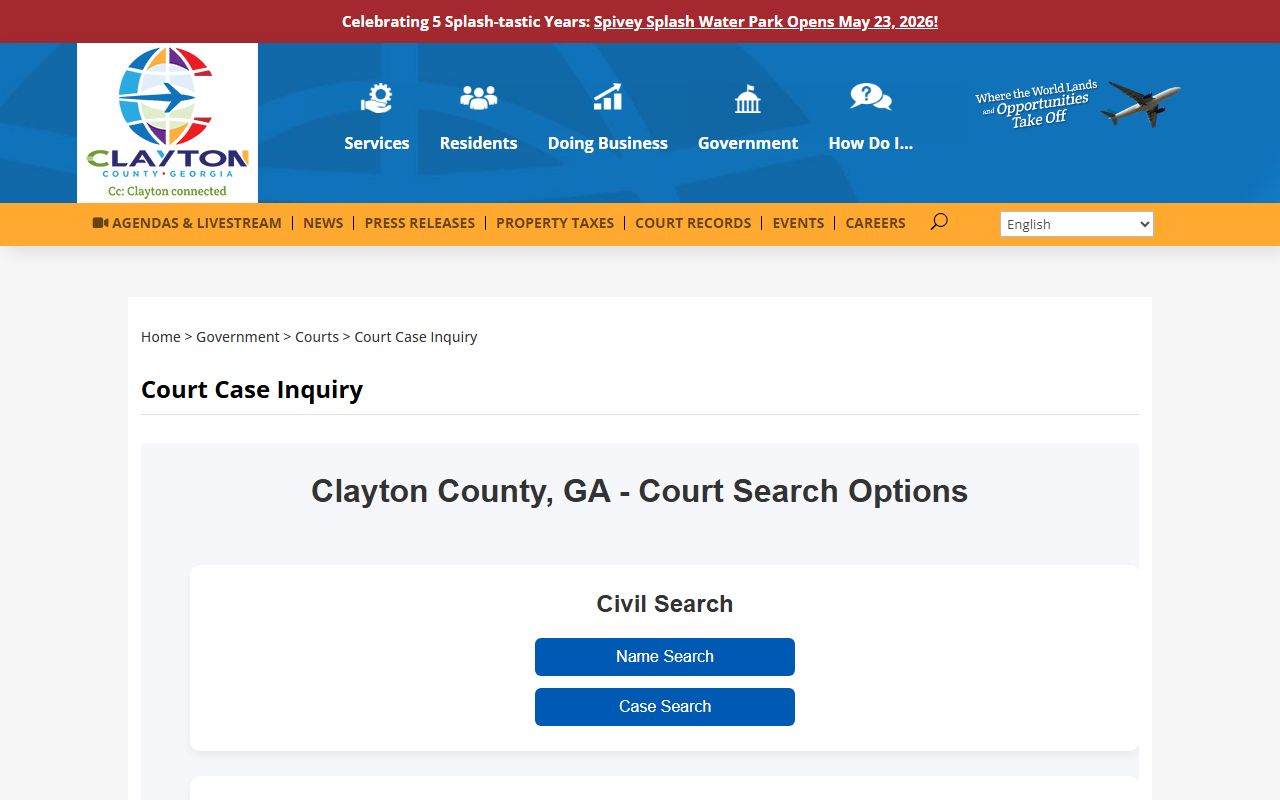
The portal screen visible on that page shows two main cards, Civil Search and Criminal Case Search, plus its exclusion notice. Use this entry point any time you cannot remember the exact case number format.
The Clayton County Judicial System
Georgia uses Superior Court as its general-jurisdiction trial court. Clayton County sits in the Clayton Judicial Circuit and shares the Georgia structure described on the Georgia.gov Superior Courts page. Superior Court has exclusive authority over felony cases, divorce, equity, and title to land. State Court handles misdemeanors, traffic, and civil cases not reserved to Superior Court. Magistrate Court takes small claims, dispossessory, garnishment, warrants, and first appearances. Probate Court handles wills, estates, marriage licenses, and weapons carry licenses. Juvenile Court handles delinquency and dependency.
Five elected judges serve on Clayton Superior Court for four-year terms. The court list comes straight from the Clayton Superior Court page and matches the roster on the official Clayton Superior and State Courts site.
Case flow: Magistrate Court › State Court › Superior Court › Court of Appeals of Georgia › Supreme Court of Georgia
| Court | Jurisdiction | Case Types |
|---|---|---|
| Superior Court | General jurisdiction; exclusive on felony, divorce, equity, title to land. | Felony criminal, civil, divorce, real-estate title, lower-court appeals. |
| State Court | Limited jurisdiction within Clayton County. | Misdemeanors, traffic, civil actions not reserved to Superior Court. |
| Magistrate Court | Small civil claims up to $15,000 under O.C.G.A. § 15-10-2. | Small claims, dispossessory, garnishment, warrants, first appearances. |
| Probate Court | Probate and related matters. | Wills, estates, guardianship, marriage licenses, weapons carry licenses. |
| Juvenile Court | Juvenile jurisdiction with limited public access. | Delinquency, dependency, children in need of services. |
The official Clayton County courts landing page ties these five courts together with links to each clerk and judge.
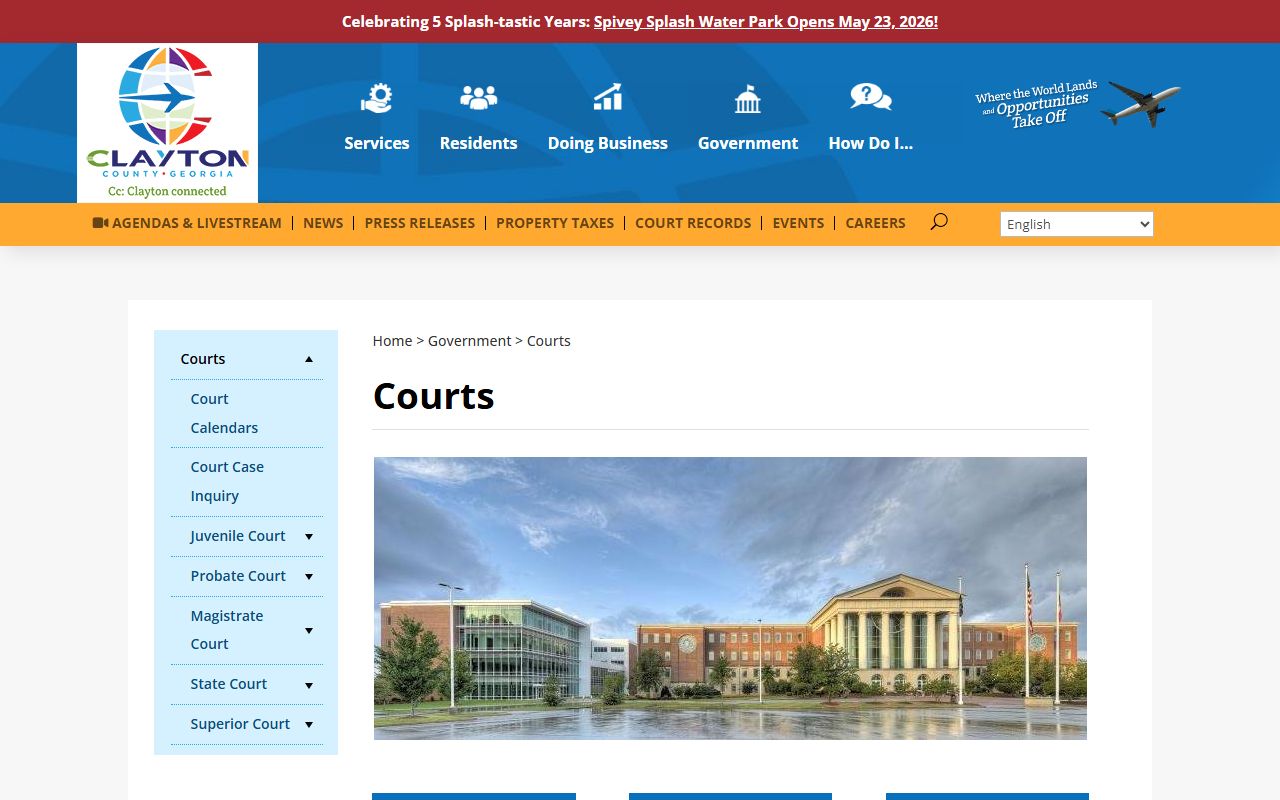
The grid view on that page mirrors the structure used across this site and is the easiest place to start when you are not sure which court hears a particular matter.
Clayton County Courthouses
The main court campus runs along Tara Boulevard in Jonesboro. Superior Court, State Court, the Clerk of Superior Court, and the Sheriff are all clustered there. Probate Court is downtown in Annex Building 3 at 121 South McDonough Street. Juvenile Court is at 9163 Tara Boulevard in its own building. Visitors should check the building address before driving, because Probate users sometimes show up at Tara Boulevard by mistake.
Harold R. Banke Justice Center
9151 Tara Boulevard
Jonesboro, GA 30236
(770) 477-3395
Clayton County Sheriff's Office
9157 Tara Boulevard
Jonesboro, GA 30236
(770) 477-4479
Probate Court (Annex Building 3)
121 South McDonough Street
Jonesboro, GA 30236
(770) 477-3299
The Banke Justice Center holds Superior Court, State Court, court administration, the law library, and the office of Clerk Chanae Q. Clemons in Room 1CL25. The Sheriff's Office sits next door at 9157 Tara Boulevard under Sheriff Levon Allen. Juvenile Court anchors the Tara Boulevard court row a few doors up. Probate Court is the outlier and is downtown.
Types of Court Records Available in Clayton County
Clayton County keeps a wide mix of court records. The right place to look depends on the case type. Civil and criminal Superior, State, and Magistrate cases live in Court Case Inquiry. Probate matters live with Probate Court. Juvenile matters are confidential and are not on the public portal. Real-estate records sit with the GSCCCA statewide search from 1985 to current.
Common record categories you will find through the county and its partner sites include the following list. Some records can be viewed online for free; others have to be requested in person or in writing.
- Criminal records — Superior felonies, State misdemeanors, and Magistrate warrant or preliminary entries.
- Civil records — Superior, State, and Magistrate civil suits, including dispossessory and garnishment.
- Family records — Divorce and related actions filed in Superior Court.
- Probate records — Wills, estates, guardianship, and marriage licenses at Probate Court.
- Traffic records — State Court traffic cases prosecuted by the Solicitor-General.
- Real-estate records — Deeds, plats, and liens recorded by the Clerk of Superior Court.
The State Court page spells out the misdemeanor and traffic role, and the Magistrate Court page covers small-claims and warrant work.
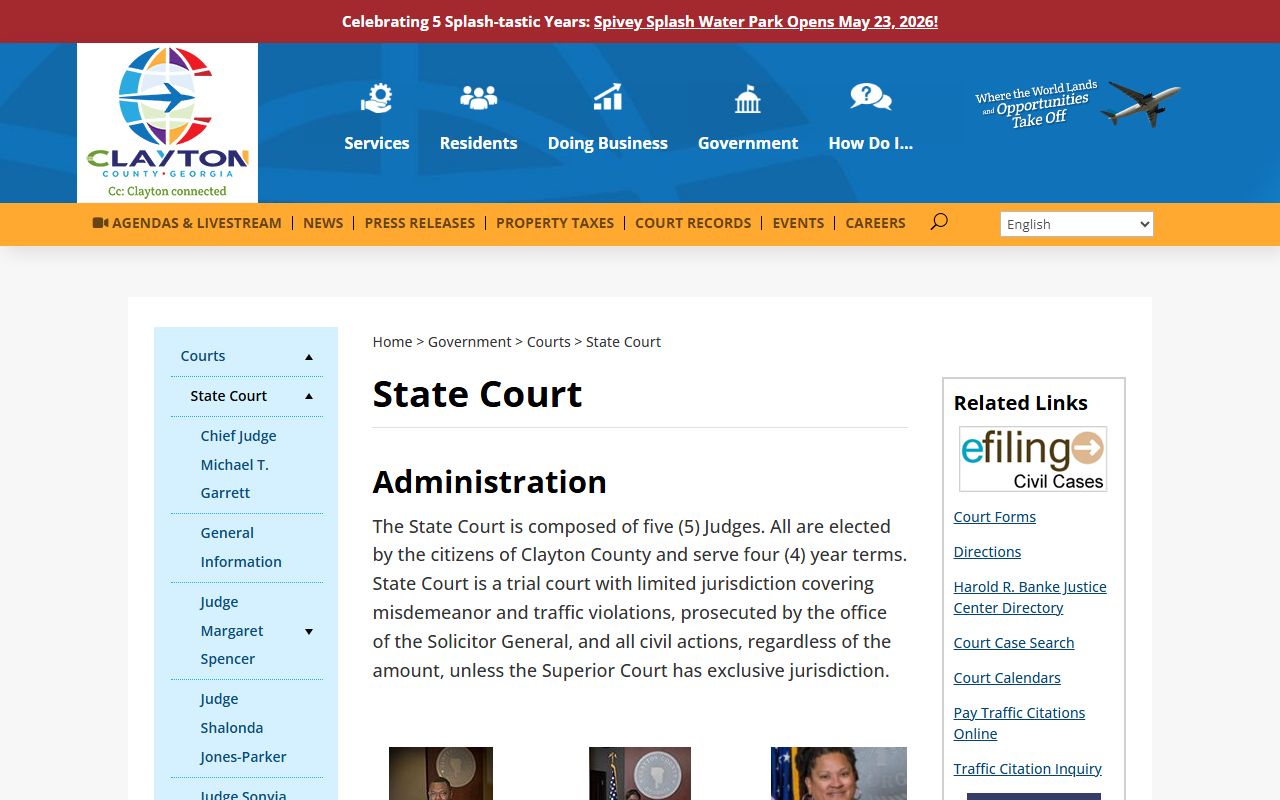
The State Court page also lists pay-traffic links routed through the Clerk of State Court for citations.
What Clayton County Court Records Show
A Clayton case-detail page reads like a docket card. It shows who the case is about, who filed it, what the charge or claim is, and what the court has done. Document PDFs are not posted in the inspected sample. Users who want certified pleadings or orders go through the clerk. The structure below comes from a State Court traffic case inspected on the public portal.
| Field | What It Shows |
|---|---|
| Case Number | Year, two-letter type, sequence, and division. Example: 2022TK03066 D. |
| Filing Date | Date the case was opened in the court's record system. |
| Assigned Judge | Judge currently responsible for the case. |
| Status | Pending, Disposed, Bound Over, See Paper File, or similar. |
| Parties | Plaintiff or State of Georgia, defendant, party type, and any listed attorney. |
| Charges / Counts | Charge code and plain-text description of each count. |
| Docket Entries | Action date, docket action, and description of each filing or event. |
| Calendar | Court date, time, room number, and calendar type. |
| Receipts | Receipt number and dollar amount tied to payments. |
The sample case showed a 10:30 AM Room 205 Traffic Arraignment Calendar entry, a final disposition, and a $116.25 receipt. No mugshot, address, or full date of birth appeared. Only the year of birth is visible in name-search results.
Public Access Laws for Clayton County Court Records
Two different bodies of law govern Clayton County records. County agency records sit under the Georgia Open Records Act. Court records sit under the Uniform Superior Court Rules and the relevant statutes for each court. The general rule is that court records are public unless a statute, court rule, or sealing order limits access.
Key Statutes:
O.C.G.A. § 50-18-70 — Georgia Open Records Act. Sets the public-access policy for state and local agency records.
O.C.G.A. § 50-18-71 — Sets fees and timelines for open-records responses. Allows reasonable cost recovery.
O.C.G.A. § 50-18-72 — Lists exemptions for confidential, investigative, medical, and protected records.
Uniform Superior Court Rule 21 — Court records are public unless access is limited by law or by the rule's sealing procedure.
O.C.G.A. § 35-3-37 — Criminal-history record restriction; limits disclosure of certain arrest and charge records.
The county uses GovQA as its open-records portal. Court copies should usually go through the proper clerk instead of the general portal.
Records That Are Restricted or Confidential
The Clayton portal lists its own limits. Users cannot view adoption files, Juvenile Court files, Probate Court files, protective orders, sealed cases, pre-JIS records, or out-of-county cases through the public search. That list is published on the search-options screen and is not a glitch. It tracks state law on confidentiality and the way the court switched its case-management system.
To view a sealed court file, a person normally has to file a motion in the court that sealed the case. The judge weighs the public-access interest against the reason the record was sealed. Restricted GBI criminal-history records use a separate process under O.C.G.A. § 35-3-37. The state typically processes complete restriction applications in two to three weeks.
Specialty Courts in Clayton County
Clayton runs several specialty court programs through Superior and State Court administration. Drug Court and DUI Court are accountability courts that combine judicial monitoring with treatment, drug testing, sanctions, and incentives. ADR, the Divorcing Parents Seminar, and adult misdemeanor probation also run through the same office. The Juvenile Court has been a national reform leader for the Annie E. Casey Foundation's Juvenile Detention Alternatives Initiative and uses Balanced and Restorative Justice principles. The DUI Court program is described on the Clayton Courts site with sections on goals, resources, and the collaborative team.
Clayton County Sheriff and Jail
Sheriff Levon Allen leads the Clayton County Sheriff's Office at 9157 Tara Boulevard. The office runs the county jail, court security, and the active inmate lookup. The Sheriff page links the inmate search and a registered sex offender search. The official inmate information search is the only sanctioned way to look up someone in active custody.
Full inmate roster details and recent booking dockets are covered on the Clayton County inmate records page. Warrant-related work is covered on the warrant records page, and post-release status is on the released inmates page. Aggregate jail population data is on the jail population page.
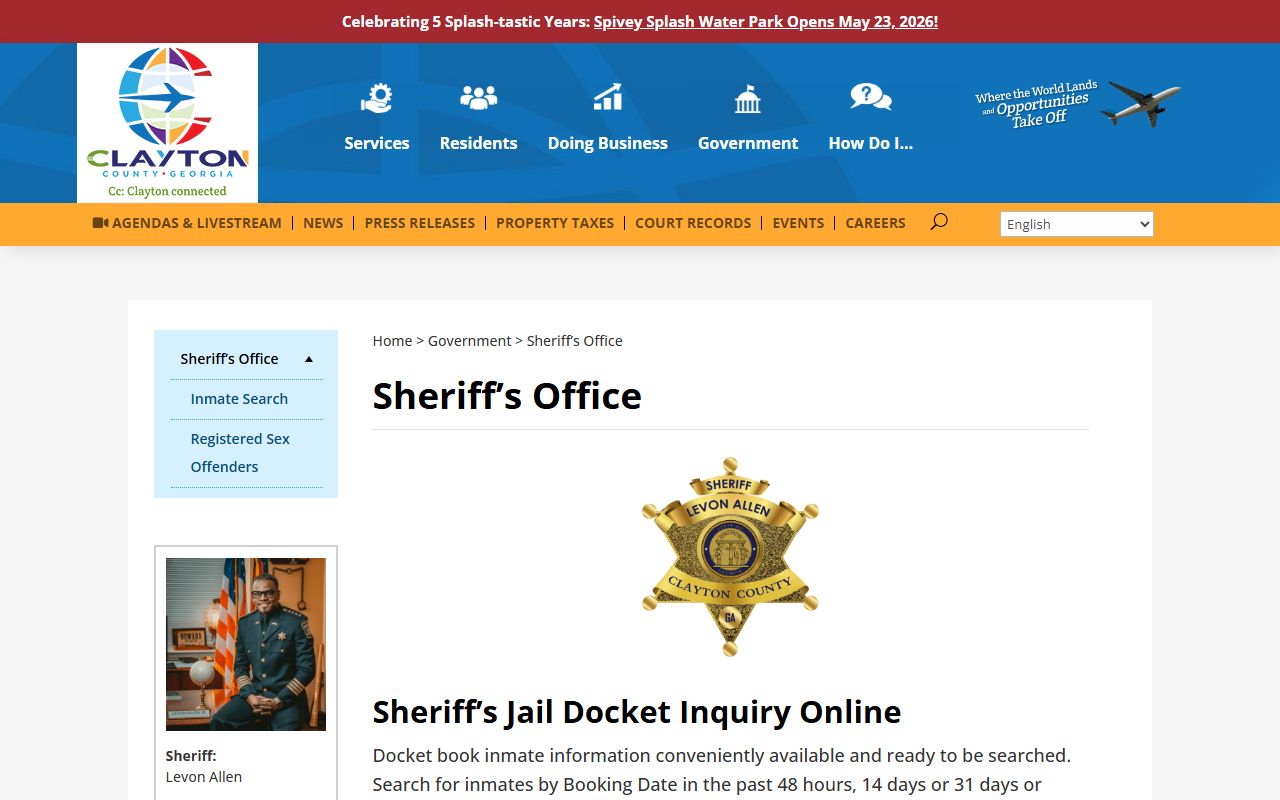
The Sheriff's page shows the agency's address, phone, fax, and inmate-search link in a single contact block.
Marriage, Divorce, and Probate Court
Marriage licenses are a Probate Court function in Georgia, not a Superior Court function. The Probate Court marriage-license page covers Clayton's requirements. Divorce is filed in Superior Court because Superior Court has exclusive jurisdiction over divorce in Georgia. The county's law library lists divorce-with-children and divorce-without-children form sets along with separation agreement, contempt, and poverty-affidavit resources. More detail is on the marriage and divorce records page and the probate records page.
- Testator
- Person who makes a valid will.
- Executor
- Person named in a will to settle the estate.
- Conservator
- Court-appointed person who manages an adult's property when a court has found the adult cannot manage it alone.
- Intestate
- A person who died without a valid will. Georgia statute decides who inherits.
Clayton County Court Records Fees
Fees vary by clerk and by record type. The Clerk of Superior Court page says certified and regular court and real-estate records can be requested electronically 24 hours a day, seven days a week. Probate Court fees are published in a separate fee schedule and run through the Georgia Probate Records filing-cost calculator. Open-records requests can carry copy, retrieval, and certification fees under O.C.G.A. § 50-18-71. Sample baseline figures are below; confirm current amounts with the clerk before paying.
| Item | Notes |
|---|---|
| Plain court copy | Per-page fee set by the Clerk of Superior Court. |
| Certified court copy | Per-page copy fee plus a certification fee for the clerk seal. |
| Open records search | Agency may charge a reasonable search and retrieval fee under O.C.G.A. § 50-18-71. |
| Probate filing | Calculated through the Georgia Probate Records filing-cost calculator. |
| Real-estate document copy | Subject to GSCCCA pricing for image and certification services. |
Probate Court has a published practical limit: it cannot accept bills larger than $50. Visitors should plan for smaller denominations or another accepted payment method.
How to Interpret Clayton County Court Records
Reading a Clayton case page is mostly about three columns: action date, docket action, and description. The case summary at the top shows the judge, the filing date, and the status. Court abbreviations in name-search results read Sta, Mag, and Sup. Common statuses include Disposed, Pending, See Paper File, Bound over to State Court, and Bound Over to Sup. Ct. A charge is not the same as a conviction. A docket entry labeled Final Case Disp shows the court's final action. Receipts and Cash Bond Forfeiture entries reflect money paid or forfeited. Calendar entries show the courtroom and the type of calendar, such as Traffic Arraignment.
Online docket entries are useful for confirming hearings and outcomes, but they are not a replacement for certified copies. If a court order or final judgment is needed for an employer, a name change, an out-of-state filing, or an appeal, the Clerk of Superior Court is the source.
Accuracy and Record Limitations
Online case data is updated by court staff as new filings and orders come in. There can be a lag between a court event and the online entry. Older paper files may show only an index entry with a status of See Paper File. Sealed and restricted cases will not appear at all. Spelling variations, married versus maiden names, and middle-name use can hide a record from a name search. Out-of-county cases are not in the Clayton portal.
Note: Confirm any case detail with the clerk's office before relying on it for legal, employment, or financial decisions.
History of Clayton County Courts
Jonesboro has been the Clayton County seat since the county's early years. The modern court campus on Tara Boulevard centers on the Harold R. Banke Justice Center. Clayton sits in the Clayton Judicial Circuit and runs the standard Georgia mix of Superior, State, Magistrate, Probate, and Juvenile Courts. The most distinctive part of Clayton's court history is its Juvenile Court, which the official page describes as a leader in innovation and reform in Georgia and nationally. The court works with CASA and the Annie E. Casey Foundation's Juvenile Detention Alternatives Initiative. On the technology side, the Clerk's office moved Superior and Magistrate civil and criminal e-filing to Odyssey on February 1, 2024, after suspending PeachCourt.
Frequently Asked Questions
How do I search Clayton County court records online?
Use the official Court Case Inquiry portal. Choose Civil Search or Criminal Case Search, then Name Search or Case Search. Name search requires a court selection and last name. Case search requires year, two-letter type, five-digit sequence, and optional division. The system covers State, Magistrate, and Superior Court and excludes adoption, juvenile, probate, protective orders, sealed cases, pre-JIS cases, and out-of-county cases.
Where is the Clerk of Superior Court?
The Clerk of Superior Court is at the Harold R. Banke Justice Center, 9151 Tara Boulevard, Room 1CL25, Jonesboro, GA 30236-4912. The phone is (770) 477-3395. Clerk Chanae Q. Clemons leads the office. The page says certified and regular court and real-estate records can be requested electronically around the clock, with fees set by the office.
Where do I find a Clayton County inmate?
Use the official Inmate Information Search. Enter a last name and refine with a first initial or first name. The system also has 48-hour, 14-day, and 31-day booking-date docket books. Name search shows only active inmates. For release confirmation, call the Sheriff at (770) 477-4479 or use VINELink notifications.
More on the Clayton County Court Records FAQ page.