
How to Look Up Clayton County Jail Population Data
Aggregate Clayton population numbers do not sit on a single official dashboard. The closest published views are the booking-date dockets on the Clayton Inmate Information Search. Those dockets show everyone booked in the past 48 hours, 14 days, or 31 days. The active name search shows only currently held inmates. Neither tool gives a denominator, a capacity, or a demographic breakdown.
For Clayton-specific aggregate numbers, an open-records request through GovQA is the right route. Ask for the most recent jail population report, capacity summary, and average daily population if those records exist. Individual name lookups for specific people go through the inmate records page, not this one.
Clayton County Jail Capacity Overview
Official capacity totals were not located in published Clayton County sources during research. Two corrections facilities are confirmed in county pages, and the table below lists what is known. The Sheriff runs the jail, and the county Corrections Department runs the Correctional Institute described on the Corrections Department page.
| Facility | Published Capacity | Notes |
|---|---|---|
| Clayton County Jail | Not located | 9157 Tara Boulevard; Sheriff-run pretrial and short-sentence facility. |
| Clayton County Correctional Institute | Not located | County Corrections Department; inmate-labor and community-service programs. |
Anyone needing a hard capacity figure should request a copy of the most recent jail budget or facility report through GovQA.
Average Daily Population
Average daily population is the standard jail measure used in state and federal reports. It is not the same as the snapshot count returned by the active inmate name search. Average daily population is calculated over a reporting period and accounts for short-term bookings, releases, and transfers.
For Clayton-specific average daily population, two official routes exist. The first is a GovQA open-records request to the Sheriff. The second is the Bureau of Justice Statistics Annual Survey of Jails, which sometimes covers Clayton when the agency is in the sample. Both require waiting for the response or the publication cycle.
Demographic Breakdown
Demographic counts for the Clayton County Jail are not published online. Sample inmate detail pages show sex and race for each booking, so the underlying data exists in the Sheriff's system. Counties usually publish demographic summaries only when required by state or federal reporting cycles. Researchers should look at the Bureau of Justice Statistics jail series and the Vera Institute county profile for Clayton-specific numbers where they have been published.
Pretrial vs Sentenced Population
County jails generally hold three groups: pretrial detainees, sentenced misdemeanants serving short county time, and people held on detainers for other jurisdictions. Pretrial detainees usually make up the largest single category in Georgia jails. The Bureau of Justice Statistics tracks this split nationwide and publishes Georgia totals in its annual reports.
| Population Group | Typical Source |
|---|---|
| Pretrial detainees | Active inmate search; pre-disposition. |
| Sentenced misdemeanants | State Court sentences served in county jail. |
| Sentenced felons awaiting transfer | Held until Georgia Department of Corrections pickup. |
| Holds and detainers | Federal holds, state holds, other-county holds. |
Misdemeanor vs Felony Population
State Court misdemeanor cases and Superior Court felony cases generate different jail population pressures. A misdemeanor defendant is more likely to be released on bond quickly or to serve a short sentence in the county jail. A felony defendant is more likely to be held pretrial pending grand jury or arraignment in Superior Court. The District Attorney prosecutes the felony cases. The Solicitor-General prosecutes the misdemeanor cases. Both choices affect how long a person sits in the Clayton County Jail before resolution.
Mental Health and Medical Population
The Sheriff and the Probate Court both have roles tied to mental-health custody. Probate Court has authority over involuntary hospitalization in Georgia. Those cases are sensitive and are not on the Court Case Inquiry portal. The Sheriff runs medical and mental-health programs inside the jail. The sample inmate detail page reviewed in research did not show medical flags or housing assignments, which is appropriate from a privacy standpoint. Aggregate mental-health population data, when available, comes through open-records requests or the BJS jail series.
State and National Context
The Bureau of Justice Statistics publishes the standard national jail and prison data for the United States. The Vera Institute Incarceration Trends tool offers county-level profiles where data is available. The Prison Policy Initiative Georgia profile is a useful overview of Georgia incarceration trends, including how local jail use compares with state and national averages.
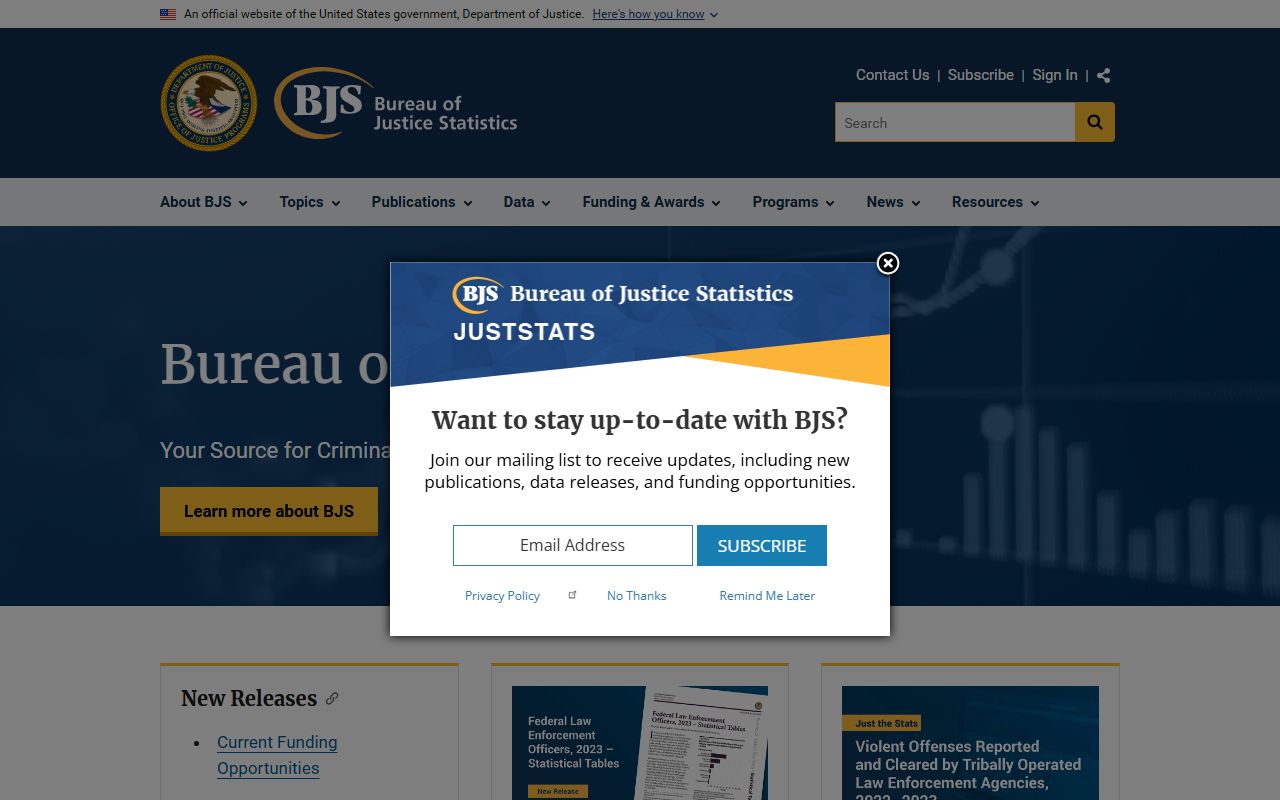
The BJS homepage above is the entry point for jail and corrections data series that include county-level Georgia data.
Comparison — Rates per 100,000: County jail incarceration rates per 100,000 residents are the standard comparison metric. State and national rates are published annually by BJS. Use those rates to put Clayton numbers in context once a county figure is in hand.
Population Trends Over Time
Long-term Clayton-specific population trend data was not located in captured official sources. The Corrections Department page describes a 2009 departmental consolidation aimed at improving efficiency and reducing duplication across county operations. That milestone is one of the few dated trend points in published county text. For long-term trends, the BJS Annual Survey of Jails and the Vera Institute incarceration trends tool are the closest authoritative options.
Where the Data Comes From
The chain of custody for Clayton population numbers runs from the Sheriff's booking system to county budgets and to state and federal reports. The Sheriff's jail-management system records individual intakes and releases. The Sheriff's published inmate search exposes only the active and recent-booking views. The county budget can include capacity totals. State and federal reports aggregate Clayton numbers along with other Georgia counties.
| Source | What It Provides |
|---|---|
| Clayton Sheriff inmate search | Active inmates and recent booking dockets. |
| GovQA open-records request | Reports the agency has but does not publish. |
| Bureau of Justice Statistics | Annual jail series with state and county data. |
| Vera Institute Incarceration Trends | County profile with admissions and ADP. |
| Prison Policy Initiative Georgia profile | State-level breakdown and context. |
Searching for Clayton County Inmate Records by Name
Individual name lookups are a different page. This page covers aggregate population data. For a name search, use the Clayton County inmate records page. The Sheriff search returns individual booking records. Aggregate population only comes from open-records requests, BJS data, or Vera Institute profiles.
How Jail Population Numbers Get Counted
Different agencies count jail population in different ways. A clear understanding of the methodology helps when comparing Clayton County data with state or national figures. The numbers that matter most are below.
- Active inmate snapshot — The number of people in custody at a single moment.
- Booking count — The number of intakes during a period. A person booked twice counts twice.
- Average daily population — The mean count over a reporting window, often a year.
- Rated capacity — The facility's design capacity per state standards.
- Operational capacity — The capacity the agency can actually staff and operate.
- Pretrial share — The percentage of the daily population held without a conviction.
The Clayton public inmate search is a snapshot tool. It cannot calculate average daily population, capacity ratios, or pretrial share without help from supporting data the agency does not publish online.
Using Open Records to Get Jail Counts
An open-records request through GovQA can pull jail totals that are not on the public site. The request should be specific. Useful items to ask for include the most recent jail population dashboard, the average daily population for the last fiscal year, the pretrial and sentenced split, the demographic breakdown by race and sex, and the rated and operational capacity. The Georgia Open Records Act under O.C.G.A. § 50-18-71 allows reasonable cost recovery, and the agency does not have to create a new record if none exists. Asking for an existing report or dashboard tends to work better than asking for a custom calculation.